Showing posts with label humanity. Show all posts

Wednesday, April 13, 2011

"Keeping the Boys Satisfied"?

Despite its relative recency, cyberpunk as a subgenre tends to produce the type of works that we might quickly classify as “men’s” or “boys’” books. This seems a little perplexing at first blush: Women and men (girls and boys) are equally human after all—there’s no logical reason why one gender should prefer playing with the boundaries of that humanity more than the other. Furthermore, as Donna Haraway discusses in her article (and Jasmine discusses in the post below), one could even argue that the melding of biology and technology ought to cross gender lines by its very nature. Still, the trend persists.


The Psychology student in me is tempted to chalk this phenomenon up to social influence norms—we perceive gender norms that tell us, from the moment we’re old enough to comprehend them, what should interest us and what shouldn’t, which toys and books and colors and classmates we’re supposed to like and which are inherently unsuitable. In most cases, these norms are quickly assimilated—a young girl chooses to play with a doll rather than a toy truck because she wants to, not because she’s trying to conform to social pressures. Young children are honest that way.


I imagine that literary tastes evolve in the same way. A boy entering the age at which he begins to pursue novel-reading independently (perhaps middle school) might find himself ridiculed if he chooses a book with too heavy a romantic subplot, or with a female lead. Similarly, a girl might find herself struggling to make friends if she shies away from whatever “chick-lit” media is currently popular in favor of, say… a sci-fi, cyberpunk “boy book”. Older children can be cruel that way.


Although arguably attributable to these norms, I believe that other factors contribute to the perception of cyberpunk as a “male” subgenre (and to the perception of scifi as a principally “male” genre) as well. As Nixon points out, many science fiction works (particularly the older ones, the “classics”) are clearly aimed towards a male audience, with “macho” ideals and female characters relegated to sexual icons, sidekicks, or shadowy background figures. To give a specific example, Nixon describes the cyber matrix we see in Neuromancer as a “feminized” world, making the cowboys’ hacking into a sort of sexual metaphor. (While I personally did not notice this comparison, I can see it in retrospect and I suppose one could make an argument for a subliminal interpretation— a particularly appropriate explanation considering the Freudian themes that Nixon applies to cyberpunk as a whole). Similarly, our hero is very much the “lone Cowboy” figure, promoting the “masculine” ideals of individuality and ambition against the “feminine” collective. While Molly is arguably a strong character who doesn’t necessarily conform to cyberpunk’s darker female stereotypes, she lacks depth. I’ve not finished the book, yet, so I apologize if this changes, but it seems that we never really get into her head, or come to appreciate or honor her motivations. She reminds me somewhat of the character of Trinity from the Matrix—a fighter, yes, but after introducing the hero to his new environment, she steps into the background and remains there, as a key but shadowed support figure except for instances in which her body is objectified sexually.

Saturday, April 9, 2011

Sapience, Modification, and the Human-Technology Interface

In my mind, one of the biggest subjects broached by Neuromancer concerns what defines humanity or, more broadly, true sapience. These issues obviously factor in when discussing the AIs present in the Novel ("Wintermute" and the titular "Neuromancer") but are also addressed through four of the primary characters: Case, Armitage/Corto, Molly, and McCoy Pauley (The "Dixie Flatline"). Throughout the book, we are constantly questioning what does it mean to be human? What is reality in a world of tangible cyberspace? Where is the line between life and death, man and machine?

The fundamental issue behind these questions of humanity are in the cyberpunk-esque future described by the book. In this future, "Console Cowboys" navigate cyberspace by plugging in and traveling through it as though it were a tangible reality. Furthermore, systems exist such that a "force-feedback" of sorts can be returned the user with the inputs usually either another individuals sensations or a sufficiently advanced AI capable of mimicking true physical reality. These themes are already ones we've touched upon in this course, the former parallels the sockets in Delaney's Nova while the latter is something akin to Mogran possession. However, Neuromancer combines the two via cyberspace and as a result deals with all the problems these books otherwise raised independently.

Megaregions -> Sprawl -> Cyberspace as an Escape

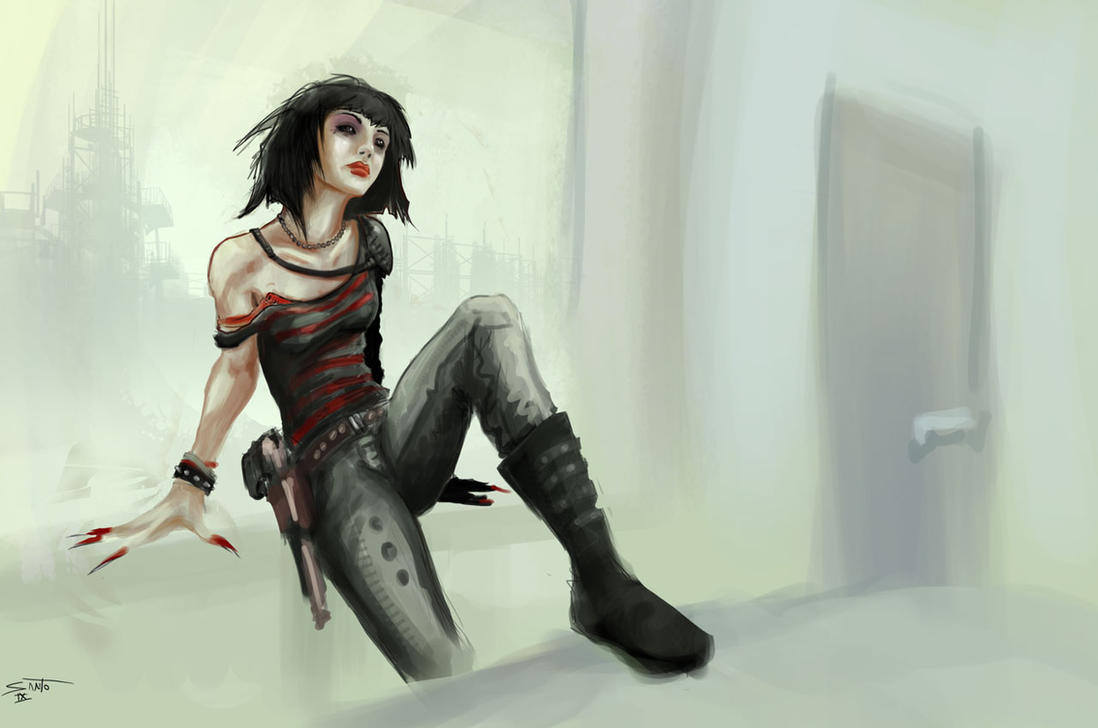
Continuing the individual parallels, Molly, Armitage/Corto, and Dixie all match characters or ideas from the aforementioned works. Molly represents the extent of technological self-modification with her mirrored eyes, razor-tipped fingers, and general physical improvements (similar to the cyborgs of Nova, there being a difference between her modifications and those made by an enterprising Demon). Armitage represents a false personality implanted over an exiting being (like a possessed being from Body Surfing) while conversely Dixie is a disembodied consciousness (paralleling a Mogran). The unique character in the mix though is the protagonist Case himself. Case has the modifications allowing him to connect and navigate the web yet is otherwise in full command of himself. Nonetheless though, he is addicted to plugging in and hacking to the point of becoming detached from reality. He constantly refers to his own body as mere flesh and a limitation and even seems to criticize his relationship with Molly as driven by the corporeal body.

Molly Millions as Imagined by a Web Artist

These relationships, all machinated or influenced by the AI known as Wintermute, show not only the varying levels of man-machine interface but also begs the question of what defines humanity? Is Armitage human because he possesses a true body or is he not because "he" has been forcibly implanted over Willis Corto? Is Case human for a similar reason even though he at times detests the physical world and seeks cyberspace as his true home? Is Molly human despite her extensive modifications to become a living weapon? Is Dixie still human despite lacking a body and existing only as a flash-imprint of his true self on a computer's hard drive? Controlling everyone is Wintermute whose existence and motives encourage us to question the validity of the Turing Police or the AI's own motives.

I don't know the answers to these questions but I do know that worry about the future of our species. All things considered, computer systems are more vulnerable than the physical world. If we are all plugged in come the year 2050+, all it takes is a rogue bit of code to throw everything off. A metaphorical virus turned real which would expand far faster and with a higher "fatality rate" than any disease known. Because of our cyber-humanity, would we be able to or want to live forever? Who are we if we are reduced to a Dixie-like construct? If we all are just effectively computer programs, who is to say that AI's cannot be citizens or people too? The lines will blur and quite frankly, I fear that day.

Wednesday, April 6, 2011

He’s climbing in your windows

Jokes of bedside manner aside, Invasion of the Body Snatchers was troubling in several ways. The first problem is that the feature character Dr. Bennell was a curious choice in his role as the active defender of free human will and patriarchy (“They’re after all of us… Our wives, our children, everybody!”). One problem was that he was a doctor, so that the privacy of physician-patient privilege only added to the covert aspect of the story. Not that it stopped Dr. Bennell from blabbering about his patients’ troubles with Becky or Dr. Kaufman, which of course is perfectly within legal bounds, but it automatically put the police in an antagonistic position throughout the film, even before evidence of their infiltration by the pods. I suppose the broader idea here is that of “secret knowledge,” something that Dr. Bennell alone possesses as his ticket out of Santa Mira (and which Steffen-Fluhr would say is another misogynistic reference of the film). Dr. Bennell is forced to consider doubt about his knowledge, notably by Dr. Kaufman, but his stubborn support for his own totalized interpretation of the small secrets of town, and his ultimate vindication, support the notion of an absolute knowledge about the other, whether it be the neighbor across the street or from the sky. Furthermore, medicine has never historically been about truth as much as amelioration.

The second problem is the dual uplifting of and disregard for science. Dr. Bennell remarks somewhat nonchalantly that the pod was a genuine possibility given the tremendous strides of science in his time. So while it may technically be alien proper, the pod may equally be considered an inevitable product of human knowledge. Of course, the destructive relationship between pod and person doesn’t really glorify the role of science in society (shameless plug). All sorts of technology, even agriculture, are literally sapping away our feelings from under the rug. Dr. Bennell and Becky have to retreat to the (prehistoric) cave to survive, albeit temporarily. Kaufman’s (semi-)rigorous psychiatric analysis suffers a similar setback. Like Bennell, Kaufman is a doctor and voice of authority, but as a voice of science he cannot be trusted! Bennell’s intuition proves superior to Kaufman’ psychologic, just as Bennell’s irrational faith in the necessity of emotion as an identifying part of humanity triumphs the cold argument for removing emotion as a less “complicated” way of life.

The third problem is Bennell’s activism, which is unusual given his oath to elevate life above ego. Somewhat in the spirit of generalizing over all premeds, I’d say Dr. Bennell might have better kept to his degree by allowing life to continue emotionless rather than using his special knowledge to resist. To him, the human shapes incubating in the pods were not fully human and therefore not fully qualified as life, giving him the right to equip the pitchfork and do them in—a rather sage presage of the future conflict for legalizing abortion. It’s suggested that he gets so emotionally invested because he sees a developing body of Becky, but the fear of these humans of artificial, scientific origin goes around Bennell, Becky, Jack, and Wendy. For the same suggested love, Bennell also breaks into Becky’s house and just sweeps her away out of the sanctity of the home. He is a doctor, as he constantly reminds Becky, and apart from passively accepting patients he is very willing to intervene even when it nullifies their privacy. (House, anyone?)

Taken together, these three problems about the portrayal of science and Dr. Bennell, the Scientific Man, suggest that there is something unnatural about science and the scientific thought behind modern medicine. The relationship between human and science is not limited to that of user and tool but one encompassing reverence, fear, skepticism, and the loss of free will. It is not really a rejection of science, since educated skepticism may be scientific, but Science, with its promise of absolute knowledge and its own academic hive mind, looks like a really scary thing and is perhaps essentially other to us, its practitioners, because of our own innate irrationality, i.e. our emotions. It may also be a revival of Frankenstein; do the products of science have rights beyond their creation by mere humans? Do we look at the pods in horror because they are absolutely and irrevocably alien (like the planet in Solaris), or because like the doctor we cannot be driven to concede our obsolescence, some feature of our human identity which we hold as unique despite a scientific novelty?

Tuesday, March 22, 2011

GERTY and HAL 9000

0 comments
**Spoilers abound for both Moon and 2001: A Space Odyssey**

It's pretty obvious to me that Jones had 2001: A Space Odyssey as one of his inspirations for Moon (luckily Wikipedia agrees with me on this one; parallels between HAL and GERTY include but are not limited to: the eye, the voice, the "I can't let you go outside, Sam"/"I'm sorry, Dave, I'm afraid I can't do that"). And with that knowledge, the ending became even more poignant. In many ways, GERTY reflects a conception of AI that HAL also reflects. They both have programming, a mission, and something which seems to exist beyond those: emotion. In the movie version of 2001, it is not so clear that HAL really has human emotions, except for a few moments where HAL seems to speak with pride in its perfect operational record. In the novel, Clarke ventures deeper into HAL's subjectivity, and gives HAL a complex set of motivations and emotions that turn it into the most human character in the novel (in my opinion, at least). Back to the movie version of 2001: the ultimate confrontation in the narrative is not between Dave and the alien intelligence as represented in the monolith, but between the human intelligence in human form-Dave, and the human intelligence in computer form-HAL. Dave and HAL find themselves opposed to the point of death, as they feel that their mission is compromised by the other's existence. Dave wins this battle, in perhaps the saddest scene in the entire movie.


The entire sequence leading to HAL's death, with its efforts to persuade Dave not to kill it, Dave's slow removal of the vacuum tubes, HAL saying "I'm afraid", HAL's singing of "Daisy Bell"

Throughout the movie, HAL only interacts with the crew through its eye and through its voice. GERTY, on the other hand, has a convenient screen for expressing emotions. Though this screen should help establish GERTY as a more human character, I actually found this screen almost distracting as it was such a transparent effort to give GERTY a recognizable face.


Two images of GERTY, one of its crying face and one of its robotic arm reaching out to comfort Sam. Which seems more human?

It detracted from GERTY's actions, which on their own create a dynamic, conflicted character. It attempts to keep Sam (#2, I think, even though he seemed to be clone 6 in the movie; it's just more convenient to label the two Sams we see #1 and #2) inside the base, but then it turns around and saves Sam #1. It hides the live feed from the Sams, but then reveals to Sam #1 that he is a clone, one of many. It helps Sam #1 access the logs, and asks Sam #2 to effectively kill it because it will tell the ELIZA crew what happened. GERTY is obviously programmed by the LUNAR company (so many acronyms in all caps!), but has developed a sort of personality through the years of working with Sams on the base. It likes Sam, beyond its programming. (True, a computer should not develop things outside of its programming, but I suppose this is in a world where GERTY is a true artificial intelligence and can pass the Turing test easily.)

So it's depressing when the same opposition between human intelligence and artificial intelligence is played out between Sam #2 and GERTY. He kills it, as much as he would be dead if it had killed him. GERTY's personality, all the quirks it developed, all the attachments it made, are wiped out by the restart that GERTY asks Sam #2 to do. This reboot is practically the same thing as one Sam dying, only to be replaced with another one with the same initial memories and same start-up procedure. Yet that death is small and in the background, compared to Sam #2's journey to earth. Sam #2 doesn't feel that death in the same way he feels his own death, perhaps because he doesn't see the similarity between him and GERTY. Yet when he says, "We're not programmed. We're people. Understand?", perhaps he means "Sams and GERTYs" as much as he means "Sams".

Three Years on the Moon

0 comments
I have only had time to see Moon, so far, so that is what I will be posting about this week. Alas, there is plenty to say.
As soon as the infomercial for Lunar Industries at the start concluded, and the heavy handed ominous music began, it was clear to me that something was amiss on the lunar base. The first moment I realized that Sam was probably never going home was when there was an obvious cut in the video communication with his wife, and Sam called out for GERTY to fix it, but he was too distracted to ultimately question what had gone wrong.
As the end of the film approached, it was my understanding that these Sam clones were designed to only have a three year life span, which is why the first Sam became increasingly ill over the final few days before he was 'scheduled to return home.' However, I read somewhere after the fact that his illness was due to overexposure to the atmosphere. Further, that even if the clones were healthy after three years, they were still executed, so that a new Sam could emerge and take over the human duties that need to be performed on the base, and live out his three years. I suppose it doesn't really make a difference as the clones have a three-year life span either way.
Before I begin discussing ideas about cloning and humanity, I had a minor moment of confusion that I am hoping someone can clear up. I understand that they had to call it 'a rescue mission' in order to maintain appearances for the newly awakened Sam, but when the 'rescuers' arrived at the crashed rover they said something along the lines of, "Well he's not going anywhere." Wouldn't that be a given since this Sam was at the end of his three year contract and was scheduled to be executed soon? Was that just an incidental comment, and the point of the rescue mission was to clear up damage from the crash?
Returning to the idea of these clones as having a three year life span--I thought it was very interesting how they kept the clones complacent. The idea of artificial memories being implanted in these clones reminded me immediately of Dollhouse and Total Recall. The Dollhouse's ability to manipulate memory is far more advanced than the manipulation in this film. It seems that the very need to implant these clones with a back- story and family life to enjoy, underscores their humanity. These are definitely not replicants that feel nothing but can perform human tasks -- they are real humans with complex emotional interiors. Of course, this film centers around a glitch in the smooth system of rotating in a new Sam every three years, so we see the whole system fall apart. What is revealed is a morally bankrupt corporation that is participating in the creation of life only to then engage in mass murder of the very lives created--there were many Sam clones waiting on the lower decks.
I liked that the film was couched in terms of energy, because the lack of energy resources on earth already causes such an immense amount of conflict-- wars, bloodshed, and death. It is interesting to see the way this film presents the deaths needed to meet the world's energy needs. Did anyone else think about the many deaths of Sam in the context of current energy crises?

Monday, March 21, 2011

Technology, Alienation and Humanity

Although both “Nova” and “Moon” imagine societies in which technological advancements are integrated into methods of economic production, I was intrigued by their differing depictions of how these advancements might affect work satisfaction. In “Nova”, workers are able to physically interact with the products of their labor by plugging into machines with their implants. This enables them to become more deeply connected with their job, making them less alienated from their everyday work and more satisfied with their job. “Moon”, on the other hand, suggests that technology might have the opposite effect, as it is set in a world in which technological advancements have enabled the establishment of mining bases on the moon which need only minimal human supervision. However, as the sole operator of his outpost, Sam has only the non-human Gerty for companionship, and constantly counts down the days till the end of his contract, suggesting that he is very much looking forward to leaving behind the terrible solitude of his workplace. Thus whereas Nova suggests how technological advancements might solve the problem of working-class citizens being dissatisfied with their working conditions, Moon depicts a future in which they actually worsen this problem.

While “Nova” and “Moon” may disagree on this point, both do appear to suggest that technology can alienate people from their humanity. During his confrontation with Lorq in the City of Dreadful Night, Prince is severely injured, and is only able to stay alive by encasing his body in a tank filled with nutrient liquids containing “alien proteins”, leaving him unable to vocalize except through a speaker. Thus medical advancements allow Prince to continue living, but in a state arguably less than human, as his body is no longer physically able to perform many actions a normal human would be able to. However, whereas Prince appears to lose his humanity in a physical sense, “Moon” suggests how technology can alienate people from their humanity from an ethical perspective. For example, Lunar Industries treats the clones of Sam unethically by using them as disposable tools and deceiving them regarding the terms of their employment contracts, but such inhumane treatment was only made possible by advancements in cloning technology. Thus both “Moon” and “Nova” suggest that technology can cause people to become alienated from or otherwise lose touch with their humanity, although in different senses.

In the process of making these suggestions, “Moon” and “Nova” raise uncomfortable questions about what exactly defines humanity. For example, the clones of Sam certainly seem very human to us, a point Sam himself drives home when he emphatically says to Gerty, “We’re not programs. We’re people.” But are they really? Normal humans do not have years of memories implanted into them, or life expectancies of only three years, as evidenced by the first Sam’s deteriorating health towards the end of his employment contract. As explained above, the extent to which Prince can be considered human after his confrontation with Lorq is also questionable, as normal human beings do not survive in nutrient tanks or vocalize through speakers. Do Prince’s and the clones’ possession of human thought processes suffice to categorize them as human? Or must the presence of a human mind be coupled with physical characteristics possessed by normal humans, in order for a being to be considered human? “Nova” and “Moon” challenge our preconceived notions of what it means to be human with these questions, but do not appear to provide any straightforward answers to them.

Friday, March 18, 2011

The Cost of Human Expansion

Everything has its price. There are the monetary costs that drive the economy (one could argue that physical harm/cost is economic). There are the moral and ethical costs from the results of one's choices. There are the emotional and mental costs centered on friendship, loss, and love. All three interact and relate to each other to influence and govern the actions of individual humans and by extension, their governments and corporations. In Moon and Nova, the characters must struggle with these costs in their lives as well as both make difficult decisions and cope with those made by others.

In Nova, the primary "costs" covered are economic and ethical. As humanity expanded from Earth over the centuries, people settled on new and distant worlds from the Sol System. As a result, these different planets not only developed different cultures, but also different principles and corporations. As Lorq's father explains to him, "the cost of transportation" is the key limiting factor in expansion and consequently the resources that govern that cost are the foundation of galactic economy. Furthermore, that cost is what drove innovation and competition between the Von Rays and the Reds and their respective companies.


As economic costs mount, and the prospects for dramatically lowering that cost rise (as in the case with Nova), additional monetary and added ethical and emotional costs are incurred to grease the gears of the economy. These ethical costs are epitomized by Dan's blindness as Lorq brought him to the nova which eventually left the former blind, deaf, and finally suicidal. Conversely, Prince Red pays dearly because of the financial and emotional (as in his own mental health) costs derived from his vengeful investment in defeating the Von Rays (Lorq in particular). Nova thus shows that despite given essentially the same circumstances and resources, humans can act and pay their metaphorical dues in wildly different ways. There is always a price to be paid for success or wealth and Lorq and Prince both have to cope with these issues. While Lorq lets these past failures force him to steel his resolve, change tactics, and improve his own abilities and understanding, Prince simply lets his fuel his fury, leading him to embrace hubris, make miscalculations, and eventually rush into the book's fatal conclusion. Samuel R. Delany is wise in understanding this foundation of the human condition: man can be irrational but more importantly, he can learn from his mistakes and try again.

Similarly in Moon, there is a more pronounced connection between the advancement of humanity and the economic, emotional, and ethical costs incurred. In a future where clean energy is abundant because of clean fusion power derived from lunar-mined Helium-3, mankind has entered a new golden age with low pollution, lower costs of living, and general economic and technological improvements brought on by solving the "energy problem". However, to ensure the clean energy supply, Lunar Industries employs (otherwise unknowing) clones of Sam Bell to man the "Sarang" mining station. Thus, economic costs of energy lead to those for the production of the clones, the corresponding ethical costs of human cloning, and then the emotional costs incurred by these clones as they suddenly become aware of how the world has/is changing. Unfortunately for these clones, Lunar Industries can only see the red and black of economic cost and thus seem unaware at best, maliciously uncaring at worst, of the trauma the "Sams" go through during their short, three-year lives.


Consequently, there is an unfortunate parallel between Moon and Nova. In short, both Lunar Industries and Prince Red only see economic costs which lead to questionable ethics in the former and self-induced madness in the latter. Both pieces serve as a warning to those of us who push the technological envelope as though we may do things faster and better now, we cannot fall into the ethical abyss, allow a "cultural stagnation," or lose our individual humanity to madness and obsession.

Wednesday, February 16, 2011

A future like ours

Don Marquis put forth the deprivation argument as reasoned opposition to the ethicality of abortion. Roughly, he argues that it is wrong to kill an unconscious embryo because it has a future that is valuable, a “future like ours.” Destroying the potential of that future (the embryo) is equivalent to killing the later-stage conscious being involved in it. Though this argument is ultimately very problematic, it speaks interestingly to the way in which we interact with the future to determine not only present worth, but also, as H.G. Wells addresses in The Time Machine and Marquis hits on in his statement, how we define ourselves, and our descendants, as beings over time, both within the span of a single lifetime and over history.

For the Time Traveler, the issue is inverted. He is presented with two peoples – the Eloi and the Morlocks – representing the bifurcated evolutionary path taken by divergent social categories which, for Wells, are a logical consequence of the physical division of populations based on economic class. Among these, he must choose that which is the rightful son of Man, which represents the future that is ours.

The world of the 8,000th century constitutes far more than a kind of recasting of Wells’ capitalist present in socialist terms (though it is indeed that). He has not produced a sympathetic laboring class which dotes faithfully on its ineffectual aristocratic charge. Rather, the conditions of labor have changed them into something altogether inhuman; unsympathetic even when the alternative is a kind of dumb petulant baby. The physical division, of decadent aristocracy increasingly buying up the Earth’s surface, while the laborer acclimates to the terms of his labor, eventuates a genetic bifurcation as the absence of class mobility and increasing cultural differences rarefy interbreeding among what become two species.

We find that the Time Traveler’s sympathies are with the dumb, child-like Eloi, while he describes the Morlocks consistently as nauseating, spidery and smelly. His actions reflect the adoption of a perspective from which only one descendant has any moral status as human. The Time Traveler saves Weena from drowning and days later begins smashing in the heads of the Morlocks, to which he is less sympathetic, but which he knows to be just as human, in a way, as the Eloi. His response to the Eloi is one of benign annoyance; for the Morlocks he has only contempt and anger.

What is ultimately at stake is which race we are going to claim as human. Wells’ future, unlike others which cast either “good” against “evil” (as are men and machines in The Terminator), is populated by human derivatives which are the decaying representations of a class system which, for Wells, discourages precisely those features (curiosity, intelligence, capacity for innovation and technology, compassion, etc.) which it, presently, purports to value above all else as human.

The Time Traveler chooses. He prefers to ally himself with the Eloi. He claims the future that is most like his as one of men turned fleshy and unthinking, but with some remnant of the aesthetic, and maybe the laughter. Perhaps it is the return of fear that he recognizes in them. He does not find his future in a brutish laboring class which has resorted to cannibalism.

The curiosity of this task of choosing is underscored by the book’s final line: “…even when mind and strength had gone, gratitude and a mutual tenderness still lived on in the heart of man.” “Gratitude” and “mutual tenderness” are not typically among the qualities which we (now or in Wells’ time), in a rational/empiricist age, list as quintessentially human. When confronted with the question of what qualities of man will survive into the future, we are forced to reevaluate what it means to be “like us,” or to have a future like ours. This obviously calls into question the futility of our own striving for knowledge/advancement, as the final chapters of the book address, while the Earth drifts into its eternal night. More importantly, though, it forces us to ask what it is about our fellow man that we find sufficiently like us for him to have moral status in our own lives, and, further, which criteria future man (or past man) must meet to warrant our present consideration. Would we make sacrifices for a future race which has fallen into decadence and decay, and which has forgotten us?

Interestingly, the first thing the Time Traveler does on his return is fill himself with mutton – finding inner carnivore unsated by the fruit diet of the Eloi. The polarized diets of the Eloi and Morlocks are symbolic of the degeneration that each race represents, an indication that it is the specialization, division, and pigeonholing of man that unravels him into separate beings which can, by present man, be either accepted and nurtured, or discarded. The reality, we find, is that the Time Traveler is related to both, though he readily discards one as insufficiently like himself and thus a kind of extra that can be killed off without moral repercussion.

Categorizing Humanity's Future

As The Time Machine emphasizes, the Time Traveller’s experience of his temporal destination is shaped by his understanding of the present. When time travellers are displaced from their own eras, they often must reframe the world by fitting it within their own conceptions of society. By imposing his “current” social/philosophical theories into the unfamiliar world, the Time Traveller simultaneously recognizes historical continuity and defines the new era through its differences from the current one. These observations probably seem intuitive and obvious, but reading and watching The Time Machine and The Terminator uses these themes to raise important questions about the way we think of the present.

One prime example of subjecting the future world to a contemporary world view occurs when Wells’s time traveller analyzes 802701 A.D. through a socialist lens. Even as he finds information that contradicts his theories, the time traveller refuses to consider that his observations can’t be explained through socialism’s theories or prophecies. Interestingly, just as George Orwell and Aldous Huxley and Ayn Rand crafted worlds that emphasize the evils of socialism, H.G. Wells shows a future where capitalism continues to widen the rift between social classes, and the “have-nots” are ultimately both crafty and resourceless enough feed off of the lazy “haves”; this is supposed to show us the dangers of not overthrowing the oppressors.

The Time Traveller also assumes that the Eloi and Morlocks descended from humans. He seems preoccupied by categorizing their behaviors as “human” or “inhuman.” One of his initial fears before he meets the Eloi is that “the race had lost its manliness, and had developed into something inhuman, unsympathetic, and overwhelmingly powerful?” (20). As he observes the Eloi and Morlocks, readers gain insight into what he considers “human” qualities - humans have language and they read and write , but the Eloi don’t. Weena seems “more human than she was, perhaps because her affection was so human” (51). He continues to cast himself as human, and the Eloi and Morlocks as inhuman, even justifying his own “inhuman” actions (“Very inhuman, you may think, to want to go killing one’s own descendants! But it was impossible, somehow, to feel any humanity in the things.” (54)) The 1960 movie version casts cannibalism as “the lowest form of human life.” It seems that humanity is often defined by what is less human or inhuman - it constitutes itself by stigmatizing its "Other" and its "inferiors." The movie version makes these divides even more clear - the time traveller only identifies with the (Aryan) Eloi, pushing them to rebel against their captors. The movie erases the only marginally-sympathetic aspect of the Morlocks - that they were the “have-nots” who were forced to hunt their captors; instead, the Morlocks always bred and controlled the Eloi like cattle.

Watching/reading about the Time Traveller’s way of organizing the future world prompted me to think about our current ways of labeling and categorizing the present and the past. When we impose a philosophical theory (ie. as Engels imposed Marxism on the distant history of humanity in The Origin of the Family, Private Property, and the State (1884)) upon “known” facts, are we forcing those details into an anachronistic labeling, one that will always be inadequate? Also, how many other things do we define through biased characteristics? (I’m sure that quite a few cultures do not have a high literacy rate or produce many formal written works, and it doesn’t make sense to deem them “inhuman” or “less human”). Also, I wonder what a time travel narrative that is entirely isolated from current political/theoretical agendas might look like (and I don’t think that’s entirely possible.) Finally, the movie definitely pointed to these questions much more at the end: should the time traveller intervene and reshape the world specifically through his 1890s knowledge of what humanity should be? That already looks odd to me - there’s already an entirely new world of theory that has surfaced in the last century, and it’s clear that the Time Traveller might have a severely narrow world view. Both The Terminator and The Time Machine raise questions about the ethics surrounding time travel, but they do not directly engage them.

Wednesday, February 9, 2011

Humanity through Martian lore: the discovery of the self through the other

0 comments

Zelazny’s A Rose for Ecclesiastes addresses notions of alterity in an interesting and indirect way. Gallinger, the pompous but linguistically gifted poet that acts as the protagonist of the story, is granted access to the cultural history of the Mars after demonstrating his considerable mastery of their “Lower Tongue.” While immersing himself in translating alien works of history and scripture, he falls for a Martian dancer that he inadvertently impregnates. Unbeknownst to Gallinger, his ensuing challenge to the Martian Matriarchy in the name of his beloved Braxa would fulfill an ancient prophecy that predicts the arrival of a savior from the sky.


On the surface, the story appears to represent a simple, colonial fantasy where the educated white man (who also happens to possess some serious martial arts training) swoops in to save the beautiful, dancing women of another world – a work of “camp” or “pulp,” as noted by a few others. The narrative itself is saturated with constant name-dropping and literary allusion, not to mention the heavily religious undertones suggested by the title. I want to argue, however, that Zelazny’s vision is more complex than what is suggested above. The scholarly (albeit pretentious) referencing, in addition to the lack of overall detail provided about the Martians themselves, appears to unpack notions of humanity more so than illustrate the speculative facets of science fiction.


First, Gallinger’s constant invoking of literary figures and allusions properly reflect his identification as a “second rate poet with a case of hubris.” Furthermore, this narrative style also serves to emphasize Gallinger’s challenge to his father’s faith; instead of becoming a missionary, the prodigious younger Gallinger chose to rebel, seek a liberal arts education, and eventually become a well-respected poet living in Greenwich Village. Ironically, it is his interactions with a dying alien society that reawakens his biblical roots. By invoking Ecclesiastes, he is able to present a positive example of struggle in the face of prophetic hopelessness. However, this does not result in his endorsing of religion or faith: Gallinger makes a point to venerate “vanity”, “pride,” and the “hubris of rationalism.” He preaches, “It is our blasphemy which has made us great, and will sustain us, and which the gods secretly admire in us.”


Several discourses of alterity can be identified within the above analysis. Most overtly, Gallinger’s dissention from religious discourse provides an alternate and more flexible way to interpret historical literature. It also addresses the issue of separating history from scripture, two elements traditionally viewed to be indistinguishable in primitive societies. Gallinger essentially highlights critical thought and western academic discipline as the major catalysts to civil and philosophical development.


The above arguments, however, are complicated by the plot twist revealed at the end of the story. That is, Gallinger’s discovery that his passionate sermon had actually fulfilled the very Martian prophecy he thought he was debunking suggests that faith can play a major role in humanity. Moreover, the paradox Gallinger identifies – that the “great paradox which lies at the heart of all miracles” is that he “[never believed a word of his own gospel]” – emphasizes the irony that he had been only acting on his own individual passions despite becoming the Martian messiah. Of course, the ultimate irony is the Braxa never loved him back.


[NOTE: sorry about how late I posted this – I screwed up and thought the posts were due at midnight and not noon.]

We Interrupt This Broadcast ...


I was struck by the parallels between A Rose for Ecclesiastes and War of the Worlds, particularly their preoccupation with the challenges and the necessity of communication. A Rose for Ecclesiastes occupies itself with intimate contact – translation of a sacred text, personal communication and relationships. Gallinger finds himself growing in knowledge but not always able to understand the Martian people he interacts with. Some things are un-translateable. War of the Worlds deals with mass communication instead of personal contact. The humans never get the chance to try communicating with their invaders, but there’s more focus on their inability to communicate with each other, with telephone lines cut and static between broadcasts. The terror of losing mass communication really struck a chord with me in light of the current situation in Egypt. Loss of the internet and attacks on reporters greatly heightens public fear because suddenly we’re cut off from the ability to learn the story from its witnesses.


Both Gallinger and Richard Pierson act as reporters in their own stories. Some posts already touched on Gallinger’s use of metaphors, an imperfect effort to communicate things people on Earth cannot quite understand. Pierson has the same descriptive problems with his scientific approach. He can make references to tentacles and snakes but cannot quite convey what he’s seeing. He cannot put horror into words, which seems particularly relevant given the story’s setting during World War II. I thought H.G. Wells made a strong point in the interview posted on Blackboard, that Americans could still “play with terror and conflict” because the war wasn’t too close to home yet. The truth of some stories cannot be told from a distance.


The inability to truly capture a story connects to a defeatist attitude over continuing it. Martians in A Rose for Ecclesiastes and humans in War of the Worlds become complacent with their own demise because it seems they’ve arrived at the end of their stories. The Martians feel that their fate is fixed because someone already finished the story for them. Pierson is losing hope because he fears there will be no one left to read his account. In both cases, though, persistence emerges from seeming futility. Gallinger uses the pessimism of the Book of Ecclesiastes as a source of optimism – the writer thought the people had no chance, but they survived anyway. While the Martians don’t respond to his humanity in the emotional sense, they do accept it in the logical scientific sense in correlation with their own sacred texts – his humanness will allow them to reproduce with him. Such a literal expression of humanity also saves the day in War of the Worlds. Humans lived on because of their own mortality. The death of some allowed for the survival of the rest because it brought on bacteria that the invaders could not handle. Listeners get the same sense of imperfect hope that Martians do in A Rose for Ecclesiastes. We don’t learn exactly how life went on, but we know that it did.


Thus both stories find hope in the ability to prevail, though they’re not entirely hopeful. Gallinger prevails against his own will. His survival can alternately be looked at as a failure to commit suicide. Regardless, humanity persists even when it seems an impossibility. Apparent apocalypses become interruptions instead of extinctions. To me this idea is tied to the section of the radio broadcast I initially found most baffling – the musical interludes. War of the Worlds begins with interrupted interludes, and the breaking news eventually takes over the regularly scheduled musical programming. The question of what is the real interlude - the music or the stories interrupting it - arises. But ultimately, the breaking news is resolved and life can return to normal. On a larger level the radio broadcast was an apocalyptic interruption. The world ended for an hour, but then another program came on and life returned to normal. A Rose for Ecclesiastes brought music more to the forefront with Braxa’s dance, but I also made the connection between Ecclesiastes and the song based on it, “Turn! Turn! Turn! (To Everything There is a Season).” I’m not sure if Zelazny was influenced by the song or not, but it was originally recorded in 1962, a year before his story came out. I think this idea of turning and cycles of life ties in well with both stories. The song concludes on a note reminiscent of the ultimate salvation of the societies in both stories – “I swear it’s not too late.”


I’m sorry that this is a little long – it seems I'm having some of my own representation problems on detailing my responses to the stories. I still feel more comfortable with science fiction in the pop cultural sense, so as an addendum to our discussion last week, I wanted to add this link to show another place I’ve learned about science fiction through cultural references. In other words, everyone should watch Community.