Showing posts with label eternal life. Show all posts

Wednesday, April 13, 2011

Paradise Preserved

I want to expand on Shelina's and Rhiannon’s posts to address the specifics of our dependence on computers and the internet. While we often couch conversations of life shifted to the internet in terms of social networking, social interaction is not the only thing that has moved online. My roommate spilled soda on her computer and had to give it up for a week, and no one understood how she was getting work done. Granted, she has the internet on her phone and access to campus computer clusters, but it’s not that much of an exaggeration now for people to think of their personal computers in terms of “my whole life is on that thing.”


I was initially struck by the fact that Case’s disconnect from cyberspace was related to “the Fall,” (6), but I think playing out the metaphor provides some interesting complications to the question of what we stand to lose based on our reliance on computers. For Case, it seems disconnect from cyberspace really does mirror Adam’s own loss of Paradise. Tempted into breaking one big rule he's been given in his world, he loses access to it, in the process becoming hyper aware of the “prison of his own flesh,” and understanding misery and work in a new light for some time (6). From there of course the story changes – he’s granted new access to his personal Paradise and doesn’t lose it this time, and Molly’s not exactly Eve. But this idea of paradise is what I want to dwell on. Because, as Rhiannon noted, the internet can certainly serve as a haven for people. But it’s not paradise, or at least not just paradise. Increasingly, it’s everyday life. It’s where we keep our calendars and photographs, where we learn assignments and hand them in. It’s where we do our taxes, and while it isn’t yet where we perform that other certainty in life, death, that’s not that far away either. Because once your whole life is on that thing, you can lose your whole life on it too. And yes, this doesn’t apply to everyone. I still have a planner that I write things down in, and the technological advancements we have access to are not at all universal. But once we do transfer information to the internet, we become dependent on that information. Apocalypse stories so often center around a disruption in technology at this point because it’s hard to imagine life without technology. It’s hard to live life without technology, but still entirely possible. But the more dependent we are on the world of computers, the more traumatic the loss of that world if it ever occurs. Our own great Fall.


In response to Seth’s post, if we’re considering life lived online, I guess we can consider afterlife as well. The idea of coming back to life recurs throughout the novel, not just in Dixie as disembodied consciousness, but also in cases like the cryonic preservation of the Tessier-Ashpool family. There are a million versions of me on my computer and online – cover letters, creative work, pictures, personal information, everything. They’re not cognizant, but they’re me preserved, frozen in a moment in time and ready to represent me to others when called upon to do so. Facebook pages and other websites can live on even if their owners have died. If we think of Dixie as a projection/ghost, it’s not hard to make a jump to already existing technology. One final note. I've noticed as I wrote that I was repeatedly conflating computers and the internet. I guess it's because life lived and preserved on both so often overlaps.

Saturday, April 9, 2011

Sapience, Modification, and the Human-Technology Interface

In my mind, one of the biggest subjects broached by Neuromancer concerns what defines humanity or, more broadly, true sapience. These issues obviously factor in when discussing the AIs present in the Novel ("Wintermute" and the titular "Neuromancer") but are also addressed through four of the primary characters: Case, Armitage/Corto, Molly, and McCoy Pauley (The "Dixie Flatline"). Throughout the book, we are constantly questioning what does it mean to be human? What is reality in a world of tangible cyberspace? Where is the line between life and death, man and machine?

The fundamental issue behind these questions of humanity are in the cyberpunk-esque future described by the book. In this future, "Console Cowboys" navigate cyberspace by plugging in and traveling through it as though it were a tangible reality. Furthermore, systems exist such that a "force-feedback" of sorts can be returned the user with the inputs usually either another individuals sensations or a sufficiently advanced AI capable of mimicking true physical reality. These themes are already ones we've touched upon in this course, the former parallels the sockets in Delaney's Nova while the latter is something akin to Mogran possession. However, Neuromancer combines the two via cyberspace and as a result deals with all the problems these books otherwise raised independently.

Megaregions -> Sprawl -> Cyberspace as an Escape

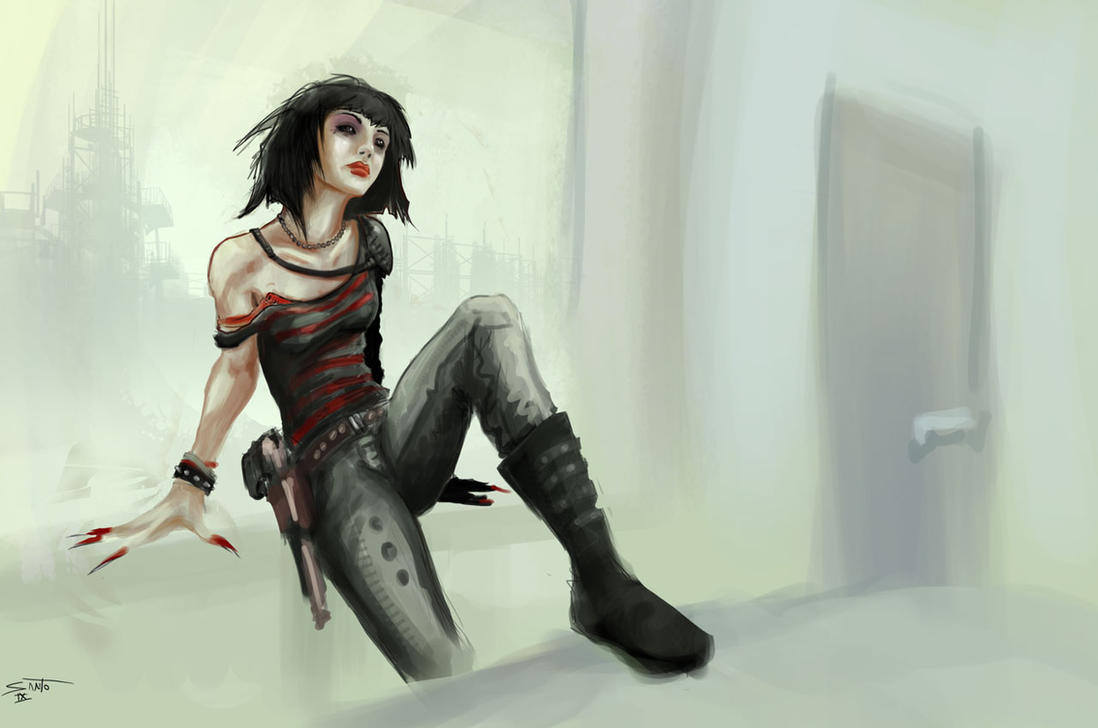
Continuing the individual parallels, Molly, Armitage/Corto, and Dixie all match characters or ideas from the aforementioned works. Molly represents the extent of technological self-modification with her mirrored eyes, razor-tipped fingers, and general physical improvements (similar to the cyborgs of Nova, there being a difference between her modifications and those made by an enterprising Demon). Armitage represents a false personality implanted over an exiting being (like a possessed being from Body Surfing) while conversely Dixie is a disembodied consciousness (paralleling a Mogran). The unique character in the mix though is the protagonist Case himself. Case has the modifications allowing him to connect and navigate the web yet is otherwise in full command of himself. Nonetheless though, he is addicted to plugging in and hacking to the point of becoming detached from reality. He constantly refers to his own body as mere flesh and a limitation and even seems to criticize his relationship with Molly as driven by the corporeal body.

Molly Millions as Imagined by a Web Artist

These relationships, all machinated or influenced by the AI known as Wintermute, show not only the varying levels of man-machine interface but also begs the question of what defines humanity? Is Armitage human because he possesses a true body or is he not because "he" has been forcibly implanted over Willis Corto? Is Case human for a similar reason even though he at times detests the physical world and seeks cyberspace as his true home? Is Molly human despite her extensive modifications to become a living weapon? Is Dixie still human despite lacking a body and existing only as a flash-imprint of his true self on a computer's hard drive? Controlling everyone is Wintermute whose existence and motives encourage us to question the validity of the Turing Police or the AI's own motives.

I don't know the answers to these questions but I do know that worry about the future of our species. All things considered, computer systems are more vulnerable than the physical world. If we are all plugged in come the year 2050+, all it takes is a rogue bit of code to throw everything off. A metaphorical virus turned real which would expand far faster and with a higher "fatality rate" than any disease known. Because of our cyber-humanity, would we be able to or want to live forever? Who are we if we are reduced to a Dixie-like construct? If we all are just effectively computer programs, who is to say that AI's cannot be citizens or people too? The lines will blur and quite frankly, I fear that day.