In my mind, one of the biggest subjects broached by Neuromancer concerns what defines humanity or, more broadly, true sapience. These issues obviously factor in when discussing the AIs present in the Novel ("Wintermute" and the titular "Neuromancer") but are also addressed through four of the primary characters: Case, Armitage/Corto, Molly, and McCoy Pauley (The "Dixie Flatline"). Throughout the book, we are constantly questioning what does it mean to be human? What is reality in a world of tangible cyberspace? Where is the line between life and death, man and machine?
The fundamental issue behind these questions of humanity are in the cyberpunk-esque future described by the book. In this future, "Console Cowboys" navigate cyberspace by plugging in and traveling through it as though it were a tangible reality. Furthermore, systems exist such that a "force-feedback" of sorts can be returned the user with the inputs usually either another individuals sensations or a sufficiently advanced AI capable of mimicking true physical reality. These themes are already ones we've touched upon in this course, the former parallels the sockets in Delaney's Nova while the latter is something akin to Mogran possession. However, Neuromancer combines the two via cyberspace and as a result deals with all the problems these books otherwise raised independently.

Megaregions -> Sprawl -> Cyberspace as an Escape
Continuing the individual parallels, Molly, Armitage/Corto, and Dixie all match characters or ideas from the aforementioned works. Molly represents the extent of technological self-modification with her mirrored eyes, razor-tipped fingers, and general physical improvements (similar to the cyborgs of Nova, there being a difference between her modifications and those made by an enterprising Demon). Armitage represents a false personality implanted over an exiting being (like a possessed being from Body Surfing) while conversely Dixie is a disembodied consciousness (paralleling a Mogran). The unique character in the mix though is the protagonist Case himself. Case has the modifications allowing him to connect and navigate the web yet is otherwise in full command of himself. Nonetheless though, he is addicted to plugging in and hacking to the point of becoming detached from reality. He constantly refers to his own body as mere flesh and a limitation and even seems to criticize his relationship with Molly as driven by the corporeal body.
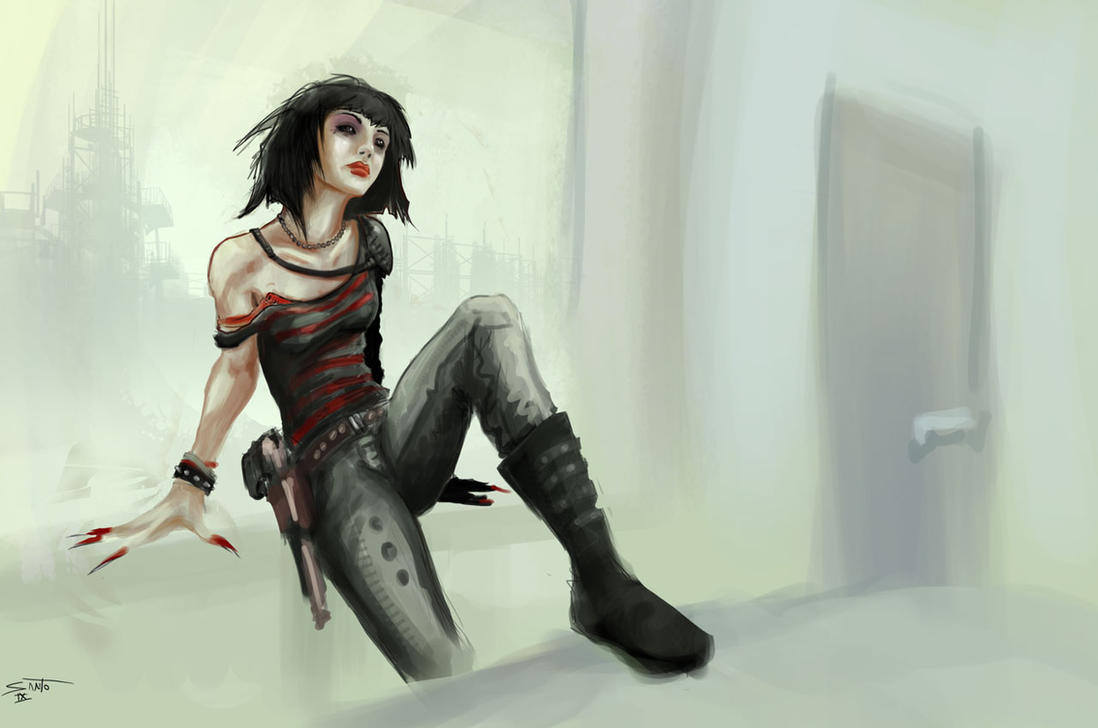
Molly Millions as Imagined by a Web Artist
These relationships, all machinated or influenced by the AI known as Wintermute, show not only the varying levels of man-machine interface but also begs the question of what defines humanity? Is Armitage human because he possesses a true body or is he not because "he" has been forcibly implanted over Willis Corto? Is Case human for a similar reason even though he at times detests the physical world and seeks cyberspace as his true home? Is Molly human despite her extensive modifications to become a living weapon? Is Dixie still human despite lacking a body and existing only as a flash-imprint of his true self on a computer's hard drive? Controlling everyone is Wintermute whose existence and motives encourage us to question the validity of the Turing Police or the AI's own motives.
I don't know the answers to these questions but I do know that worry about the future of our species. All things considered, computer systems are more vulnerable than the physical world. If we are all plugged in come the year 2050+, all it takes is a rogue bit of code to throw everything off. A metaphorical virus turned real which would expand far faster and with a higher "fatality rate" than any disease known. Because of our cyber-humanity, would we be able to or want to live forever? Who are we if we are reduced to a Dixie-like construct? If we all are just effectively computer programs, who is to say that AI's cannot be citizens or people too? The lines will blur and quite frankly, I fear that day.

